Contact Seller
The Real Wood Furniture Company
Tel01608 642741or07971 629703Please quote Antiques Atlas.

 Charles II Oak Circa 1660 Occasional Side Chair
 C.19th Elm Windsor Country Childs Rocking Chair
 Lancashire Ash & Elm Ladder Back Armchair (c.1890)
 Pair ofGothic Carved Oak Carver Chairs
 18th Century Childs Windsor Armchair
 Pair of Lancashire Spindle back armchairs
 Kitchen Chair
 Set of 5 Ercol Windsor Dining Chairs
 19thc Windsor Country Penny Seat Carver Chair
 Early 19th C Ash Country Chair
 Pair Antique Victorian Occasional Chairs
 Set of Four 18thC Oak Farmhouse Dining Chairs
Non UK callers :
+44 1608 642741
or +44 7971 629703
or +44 7971 629703
Windsor Captain’s Chair, Mixed Woods, c1890


WINDSOR CAPTAIN’S CHAIR IN ALDER, BEECH & ELM, C1890
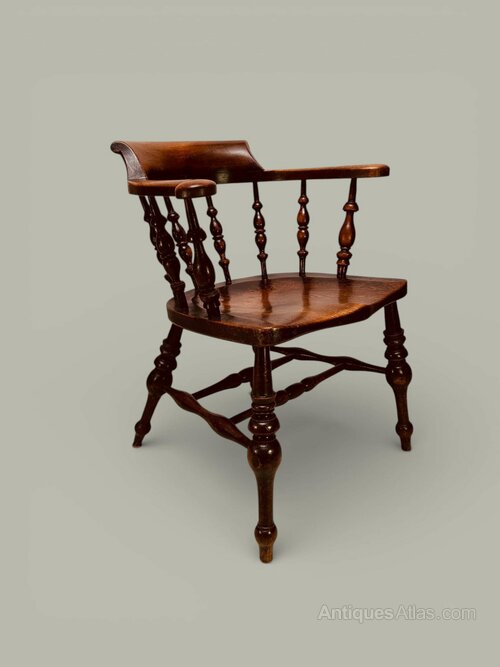
A Windsor captain’s chair with arms and top comb in alder, under arm turnings and legs in beech, with elm seat made in High Wycombe c1890. This chair shows evidence of having been used as a barber’s chair in a former life. Photographs show a slight scollop out of the back of the top comb and evidence of some kind of fixing having been attached to the rear seat edge. Barbers used to attach a head rest to chairs of this style, to make a comfortable seat for their clients. Such headrest was obviously removed from this chair long ago, as the colour of both parts is very much in keeping with wear on the rest of the chair. The maker has stamped his in initials on the rear edge of the seat ‘JC’ (unattributed) and there is also a ‘2’ stamp, which may have been added to show its station in the barber’s salon alongside other similar chairs. Its original constant use has contributed to the lovely colour. Original dark brown / black paint has worn away on the arms and top comb and most of the seat, leaving the under arm turned spindles and legs, which would not have experienced much wear, with more of their original paint finish untouched. This particular chair has an elegant grace, compared to some of its more ‘robust’ counterparts. and features a soft peak to the front edge of the saddle shaped seat. Made in the Thames Valley c1890.
width at armbow : 62 cms (24.5”)
height : 78 cms (30.5”)
depth (from back of top comb to front of legs) : 59 cms (23”)
seat height: 46 cms (18”)
between front arm supports: 41 cms (16”)
seat depth (from bottom of under arm turnings to front edge of seat) 44cms (17.25”)
Why do I call this style of chair a ‘Windsor chair’ ? I wrote a paper in support of my exhibition of Thames Valley Windsor chairs in 1998 in which I identified that the term 'Windsor chair' had evolved in its use, to describe wooden chairs whose axis of construction is the seat, ie where the legs are jointed up into the underside of the seat board and the superstucture is jointed into the top surface of the seat board. This description was endorsed in Mike Harding-Hill's excellent 2003 published book 'Windsor Chairs' (Antique Collectors' Club).
When I first started buying chairs in 1979, the term ‘Windsor chair’ was used within the antiques trade, to describe exclusively, hoop back and comb back armchairs and side chairs. 19th century chairs such as ‘Oxford’ style chairs and ‘slat and splat back chairs’ with a deep top comb rail at the top, with their sawn and shaped outer supports were typically described as ‘kitchen chairs’. As time passed by, these slightly more ‘humble’ chairs, made in greater quantities, became known as ‘Kitchen Windsor’ chairs and then eventually the ’Kitchen’ disappeared from common usage, possibly as ‘the trade’ tried to elevate their status.
Dr Bernard Cotton used the term 'Windsor' to descibe all such chairs in his 1990 published epic and definitive tome 'The English Regional Chair' (Antique Collectors' Club) for which I contributed many of the chairs illustrated. His work became a 'reference' for the antiques trade and certainly contributed to the adoption of the description 'Windsor chair' becoming a more widely used generic term.
Whatever the reasoning, an evolution in the accepted meaning / use of the term ‘Windsor chair’ had occurred, but not without reason, as the method of construction remains key, as above, in contrast to ‘frame chairs’ where the back upright extends from top to bottom, with seat rails / seat jointed into the back upright and into the front legs.
The Real Wood Furniture(Chris Baylis) has large showrooms in the Cotswolds, specialising in English Windsor chairs, but also stocking an eclectic mix of decorative and fine furniture, objects, garden pieces etc.
Open by appointment.
SellerThe Real Wood Furniture Company
View all stock from
The Real Wood Furniture Company

 Mo Tighe
Chapel House Grounds
Chipping Norton
Oxfordshire
OX7 5SZ
Tel : 01608 642741
or : 07971 629703
Non UK callers : +44 1608 642741 or +44 7971 629703
Get directions to The Real Wood Furniture Company
A Windsor captain’s chair with arms and top comb in alder, under arm turnings and legs in beech, with elm seat made in High Wycombe c1890. This chair shows evidence of having been used as a barber’s chair in a former life. Photographs show a slight scollop out of the back of the top comb and evidence of some kind of fixing having been attached to the rear seat edge. Barbers used to attach a head rest to chairs of this style, to make a comfortable seat for their clients. Such headrest was obviously removed from this chair long ago, as the colour of both parts is very much in keeping with wear on the rest of the chair. The maker has stamped his in initials on the rear edge of the seat ‘JC’ (unattributed) and there is also a ‘2’ stamp, which may have been added to show its station in the barber’s salon alongside other similar chairs. Its original constant use has contributed to the lovely colour. Original dark brown / black paint has worn away on the arms and top comb and most of the seat, leaving the under arm turned spindles and legs, which would not have experienced much wear, with more of their original paint finish untouched. This particular chair has an elegant grace, compared to some of its more ‘robust’ counterparts. and features a soft peak to the front edge of the saddle shaped seat. Made in the Thames Valley c1890.
width at armbow : 62 cms (24.5”)
height : 78 cms (30.5”)
depth (from back of top comb to front of legs) : 59 cms (23”)
seat height: 46 cms (18”)
between front arm supports: 41 cms (16”)
seat depth (from bottom of under arm turnings to front edge of seat) 44cms (17.25”)
Why do I call this style of chair a ‘Windsor chair’ ? I wrote a paper in support of my exhibition of Thames Valley Windsor chairs in 1998 in which I identified that the term 'Windsor chair' had evolved in its use, to describe wooden chairs whose axis of construction is the seat, ie where the legs are jointed up into the underside of the seat board and the superstucture is jointed into the top surface of the seat board. This description was endorsed in Mike Harding-Hill's excellent 2003 published book 'Windsor Chairs' (Antique Collectors' Club).
When I first started buying chairs in 1979, the term ‘Windsor chair’ was used within the antiques trade, to describe exclusively, hoop back and comb back armchairs and side chairs. 19th century chairs such as ‘Oxford’ style chairs and ‘slat and splat back chairs’ with a deep top comb rail at the top, with their sawn and shaped outer supports were typically described as ‘kitchen chairs’. As time passed by, these slightly more ‘humble’ chairs, made in greater quantities, became known as ‘Kitchen Windsor’ chairs and then eventually the ’Kitchen’ disappeared from common usage, possibly as ‘the trade’ tried to elevate their status.
Dr Bernard Cotton used the term 'Windsor' to descibe all such chairs in his 1990 published epic and definitive tome 'The English Regional Chair' (Antique Collectors' Club) for which I contributed many of the chairs illustrated. His work became a 'reference' for the antiques trade and certainly contributed to the adoption of the description 'Windsor chair' becoming a more widely used generic term.
Whatever the reasoning, an evolution in the accepted meaning / use of the term ‘Windsor chair’ had occurred, but not without reason, as the method of construction remains key, as above, in contrast to ‘frame chairs’ where the back upright extends from top to bottom, with seat rails / seat jointed into the back upright and into the front legs.
The Real Wood Furniture(Chris Baylis) has large showrooms in the Cotswolds, specialising in English Windsor chairs, but also stocking an eclectic mix of decorative and fine furniture, objects, garden pieces etc.
Open by appointment.
Price
Click here to message the seller The price has been listed in British Pounds.
Conversion rates as of 28/MAY/2026. Euro & Dollar prices will vary and should only be used as a guide.
Always confirm final price with dealer.
DimensionsW: 62cm (24.4")H: 78cm (30.7")D: 59cm (23.2")
Category Antique Furniture
> Antique Chairs
Date 1890
Late 19th Century Antiques Material Beech
Origin English
Item code as1264a018 / 10367
Status For Sale
£375.00 
$503.70
€432.49

$503.70

€432.49

Looking to Buy?
Arrange a final price and delivery details directly with the dealerClick here to message the seller
Conversion rates as of 28/MAY/2026. Euro & Dollar prices will vary and should only be used as a guide.
Always confirm final price with dealer.
Shipping information
Delivery to any mainland UK location and worldwide, by specialist antique carriers can be arranged and will be charged at cost.
View all stock from
The Real Wood Furniture Company
 Mo Tighe
Chapel House Grounds
Chipping Norton
Oxfordshire
OX7 5SZ
Tel : 01608 642741
or : 07971 629703
Non UK callers : +44 1608 642741 or +44 7971 629703
Get directions to The Real Wood Furniture Company
You may also be interested in
 Charles II Oak Circa 1660 Occasional Side Chair
 C.19th Elm Windsor Country Childs Rocking Chair
 Lancashire Ash & Elm Ladder Back Armchair (c.1890)
 Pair ofGothic Carved Oak Carver Chairs
 18th Century Childs Windsor Armchair
 Pair of Lancashire Spindle back armchairs
 Kitchen Chair
 Set of 5 Ercol Windsor Dining Chairs
 19thc Windsor Country Penny Seat Carver Chair
 Early 19th C Ash Country Chair
 Pair Antique Victorian Occasional Chairs
 Set of Four 18thC Oak Farmhouse Dining Chairs