Contact Seller
Christopher Tombs Ltd
Tel01386700085Please quote Antiques Atlas.

 Vintage Oil Painting by Roger San Miguel
 17th century Flemish painting, large landscape
 Ancient Italian painting from the 17th century
 Italian Oil On Canvas Painting. 17th Century.
 Oil on canvas with contemporary frame.Italy 18th.C
 Oil painting on canvas depicting a noblewoman.18tC
 A Small 18th Century Oil On Panel.
 Italian Landscape With Wayfarers, Oil On Canvas
 Italian Painting, Landscape Signed And Dated 1846
 Great 16th-century Venetian painting
 Great painting signed by Carlo De Notaris
 Great Battle Of The 19th Century, Painting Signed
Non UK callers :
+44 1386700085
Oil on Board by Gabriel Puig Roda.


We are offering to you this exceptional Painting by Gabriel Puig Roda.
(Tírig, March 18, 1865 – Vinaroz, November 21, 1919)
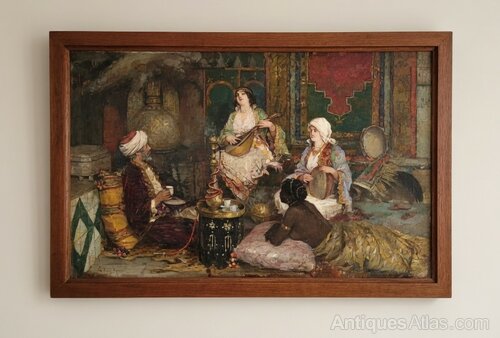
In the Harem Signed lower left G. Puig Roda Oil on panel Frame - 46.5cm x30.5cm x 2.5cm. Panel - 40.7cm x 25cm.
Exhibited: 12 eme Exposition de Peinture, Cercle Artistique, Cairo, 1902, cat. No.50 ‘Dans le Harem – Roda’, original catalogue entry preserved verso. The East, particularly the East of the Harem and the concubine held a fascination for Western artists and Western audiences throughout the nineteenth century. Our painting shows a man sitting drinking coffee with two women, who have set down their cups to playing music for him and a third woman who is reclining on a cushion gazing at the man with rapt attention. Even without knowing the title to the painting – exhibited as Dans le Harem at Cairo in 1902 during Puig Roda’s lifetime – we would recognise this as a Harem scene. Since no other man but the Sultan would be allowed to be there except eunuchs we can identify the figures then as the Sultan and three of his concubines, or odalisques as they were known in the nineteenth century.
Oriental scenes are comparatively rare in Gabriel Puig Roda’s work compared with his more familiar contum brista scenes celebrating the daily lives, rituals and vibrancy of Spanish and Italian country people. The Valencian Jota 1913 (Museum of Fine Arts, Castelló, Valencia) is a good example of Puig Roda’s skill and appeal. The Jota is a traditional Spanish dance with versions distinct to the various regions. In Puig Roda’s painting skilful effects of light and shade – the dappled shadows under the pergola in the foreground with a view of the town beyond dissolving in bright sunlight – are accented by the bright colours worn by the dancers. Music is central to the theme of Puig Roda’s art.
In our painting In the Harem it is an essential but invisible part of the painting’s narrative, as crucial to reading it as the gestures and movement of the figures. Our painting is signed G. Puig Roda but it is undated. It was exhibited at Cairo in 1902, according to the exhibition catalogue preserved on the back of the panel, when it was titled Dans le Harem and listed as by Roda. This exhibition was held during Puig Roda’s lifetime and conceivably within a decade of the picture being painted. The title may even be Puig Roda’s own.
The panel of 9 ¾ x 16 inches is of the similar dimensions to the 10 x 16 inch panel that Puig Roda used for two versions of The orange seller, one painted at Rome in 1893 (sold Sotheby’s, London, 21st June 1989, lot 544 for £52,800 including premium) and a second painted at Rome in 1900 (sold Bonhams, New Bond Street, 14th November 2006, lot 73, £33,600 including premium). Our painting is comparable in managing a figure group on the same scale and dimensions and may also date from the 1890s. Puig Roda’s contemporaries – including the notable Spanish painter Mariano Fortuny y Marsal (1838–1874) who was a great influence on him – treated Harem subjects as more straight forward pieces of wistful eroticism. Odalisques since Ingres had very little to do in art, except to stand or lie at full-length and be looked at by the viewer. Puig Roda does something remarkable within this genre. He presents the scene so matter of factly and exactly that one assumes he must have witnessed just such a party of coffee and music, even though that would be impossible. Throughout the painting the level of detail and observation creates the illusion of first-hand experience. The braided waist coat worn by the woman playing the drum is comparable with examples of eighteenth and nineteenth century gold-embroidered Turkish women’s jackets in the Metropolitan Museum of Art, New York. The ivory inlaid table is a recognisably Near-Eastern form, familiar to nineteenth century Europeans and increasingly popular with them as a piece of furniture. The singer is a playing a traditional Turkish lute known as a bağlama. Puig Roda’s skill is to present this scene as though he is showing them a piece of reportage. We imagine that the Sultan and the two musicians have just put down their coffee cups, the music has started and we are as entranced as the Sultan and the woman leaning on the cushion. The wealth of detail conjures an intense atmosphere. The walls and floor are carpeted with no glimpses of a world beyond this private and luxurious space. It is a painting about a moment, after the coffee, while the music plays and the smoke still wafts from the hookah. Puig Roda is an important figure in the history of Spanish painting in the late nineteenth and early twentieth centuries. He and his fellow contum bristas saw themselves as thematic heirs to Velzaquez and Goya who also made the Spanish peasant character an essential subject of their painting. The exhibition details on the back of our painting also place his work in the context of the development of Egyptian modern art. Our painting was catalogue number 50 in the 12th annual Painting Exhibition held by the Cercle Artistique in 1902. The Cercle Artistique, a group of Egyptian painters, poets and patrons, held its first exhibition) in 1890.Each exhibition was held during Ramadan. The 12th exhibition was held at the Cairo gallery of the great dealer and antiquary Maurice Nahman (1868-1948) and was significant in being the first that was open to women visitors. These exhibitions brought the work of Egyptian painters together with the European paintings that Egyptian painters found inspirational, and which Cairo collectors were buying. Clearly Puig Roda’s painting was admired there, further evidence that Puig Roda portrayed the scene convincingly. The other paintings visible on the exhibition catalogue are still-lifes by Irma Komlósy (1850 – 1915) an Austrian painter and an unknown painter Gibauld, a view of the entrance of a house at Taormina in Sicily by an unknown painter Binder, evening on the Nile by an artist whose name is unclear but may be ‘Oglible’ and perhaps therefore an Egyptian artist, and The slipper bath by Ralli. Théodore Ralli or Theodorus Rallis-Scaramanga (1852 – 1909), a Greek painter who divided his time between Paris and Egypt was trained by the French academic painter Jean-Léon Gérôme (1824 – 1904) and came to Egypt as a portrait painter. Ralli’s work has only been rediscovered this century, was a comparable figure to Puig Roda, whose work is rooted in scenes of Greek peasant life, but who was heavily influenced by contum brista French and Spanish painters, and his own love of Egypt, and turned to painting Egyptian subjects in an orientalist manner. Puig Roda’s In the Harem is a good example of the works that inspired him and perhaps the current went both ways. He was a central figure in establishing the Cercle Artistique and must have been involved with the choice of Puig Roda’s painting for the exhibition. Except that Cairo was a frequent port of connection, as well as a destination, for travellers in the eastern Mediterranean there is no evidence that Puig Roda himself went there. He was born in 1865 at Tírig in Valencia to a country family. An early patron, Enrico Bosch baron of Casa Blanca introduced him to Vincente Ruiz Vila, President of the local government, the Deputies of Castellón, through whose help he got a place at the Real Academia de San Fernando in Madrid. After his training there he went to Rome in 1889, where he remained with a brief return to Spain in 1893 until around 1900. In Italy he got to know a wide variety of artists and perfected his watercolour technique, seen in finely-executed works such as An artist painting in her studio 1909 (Sold Sotheby’s 17th October 1991, lot 340, £16,814 including premium) where he achieves the effect of a woman’s scarf reflected in a tiled floor, a remarkable feat in watercolour. When he finally returned to Spain he settled in Barcelona, before moving to Vinaroz in Castellónon the border of Valencia and Catalonia, where he died in 1919. His work is well-represented in the city collections of Vinaroz and Castellón, or Castelló in Valencian. In 2008 the Vinarós cultural society, La Asociación Cultural Amics deVinarós, inaugurated the International Gabriel Puig Roda Watercolour Competition in tribute to him. Delivery to you is included in the asking price and Shipping to you is a pleasure to so please do contact us for a Quote. We welcome all inquiries. Thanks for looking Chris. 07778655965
SellerChristopher Tombs Ltd
View all stock from
Christopher Tombs Ltd

 Unit 96
Northwick Business centre
Blockely, Moreton-in-Marsh
Gloucester
GL56 9RF
Tel : 01386700085
Non UK callers : +44 1386700085
Get directions to Christopher Tombs Ltd
(Tírig, March 18, 1865 – Vinaroz, November 21, 1919)
In the Harem Signed lower left G. Puig Roda Oil on panel Frame - 46.5cm x30.5cm x 2.5cm. Panel - 40.7cm x 25cm.
Exhibited: 12 eme Exposition de Peinture, Cercle Artistique, Cairo, 1902, cat. No.50 ‘Dans le Harem – Roda’, original catalogue entry preserved verso. The East, particularly the East of the Harem and the concubine held a fascination for Western artists and Western audiences throughout the nineteenth century. Our painting shows a man sitting drinking coffee with two women, who have set down their cups to playing music for him and a third woman who is reclining on a cushion gazing at the man with rapt attention. Even without knowing the title to the painting – exhibited as Dans le Harem at Cairo in 1902 during Puig Roda’s lifetime – we would recognise this as a Harem scene. Since no other man but the Sultan would be allowed to be there except eunuchs we can identify the figures then as the Sultan and three of his concubines, or odalisques as they were known in the nineteenth century.
Oriental scenes are comparatively rare in Gabriel Puig Roda’s work compared with his more familiar contum brista scenes celebrating the daily lives, rituals and vibrancy of Spanish and Italian country people. The Valencian Jota 1913 (Museum of Fine Arts, Castelló, Valencia) is a good example of Puig Roda’s skill and appeal. The Jota is a traditional Spanish dance with versions distinct to the various regions. In Puig Roda’s painting skilful effects of light and shade – the dappled shadows under the pergola in the foreground with a view of the town beyond dissolving in bright sunlight – are accented by the bright colours worn by the dancers. Music is central to the theme of Puig Roda’s art.
In our painting In the Harem it is an essential but invisible part of the painting’s narrative, as crucial to reading it as the gestures and movement of the figures. Our painting is signed G. Puig Roda but it is undated. It was exhibited at Cairo in 1902, according to the exhibition catalogue preserved on the back of the panel, when it was titled Dans le Harem and listed as by Roda. This exhibition was held during Puig Roda’s lifetime and conceivably within a decade of the picture being painted. The title may even be Puig Roda’s own.
The panel of 9 ¾ x 16 inches is of the similar dimensions to the 10 x 16 inch panel that Puig Roda used for two versions of The orange seller, one painted at Rome in 1893 (sold Sotheby’s, London, 21st June 1989, lot 544 for £52,800 including premium) and a second painted at Rome in 1900 (sold Bonhams, New Bond Street, 14th November 2006, lot 73, £33,600 including premium). Our painting is comparable in managing a figure group on the same scale and dimensions and may also date from the 1890s. Puig Roda’s contemporaries – including the notable Spanish painter Mariano Fortuny y Marsal (1838–1874) who was a great influence on him – treated Harem subjects as more straight forward pieces of wistful eroticism. Odalisques since Ingres had very little to do in art, except to stand or lie at full-length and be looked at by the viewer. Puig Roda does something remarkable within this genre. He presents the scene so matter of factly and exactly that one assumes he must have witnessed just such a party of coffee and music, even though that would be impossible. Throughout the painting the level of detail and observation creates the illusion of first-hand experience. The braided waist coat worn by the woman playing the drum is comparable with examples of eighteenth and nineteenth century gold-embroidered Turkish women’s jackets in the Metropolitan Museum of Art, New York. The ivory inlaid table is a recognisably Near-Eastern form, familiar to nineteenth century Europeans and increasingly popular with them as a piece of furniture. The singer is a playing a traditional Turkish lute known as a bağlama. Puig Roda’s skill is to present this scene as though he is showing them a piece of reportage. We imagine that the Sultan and the two musicians have just put down their coffee cups, the music has started and we are as entranced as the Sultan and the woman leaning on the cushion. The wealth of detail conjures an intense atmosphere. The walls and floor are carpeted with no glimpses of a world beyond this private and luxurious space. It is a painting about a moment, after the coffee, while the music plays and the smoke still wafts from the hookah. Puig Roda is an important figure in the history of Spanish painting in the late nineteenth and early twentieth centuries. He and his fellow contum bristas saw themselves as thematic heirs to Velzaquez and Goya who also made the Spanish peasant character an essential subject of their painting. The exhibition details on the back of our painting also place his work in the context of the development of Egyptian modern art. Our painting was catalogue number 50 in the 12th annual Painting Exhibition held by the Cercle Artistique in 1902. The Cercle Artistique, a group of Egyptian painters, poets and patrons, held its first exhibition) in 1890.Each exhibition was held during Ramadan. The 12th exhibition was held at the Cairo gallery of the great dealer and antiquary Maurice Nahman (1868-1948) and was significant in being the first that was open to women visitors. These exhibitions brought the work of Egyptian painters together with the European paintings that Egyptian painters found inspirational, and which Cairo collectors were buying. Clearly Puig Roda’s painting was admired there, further evidence that Puig Roda portrayed the scene convincingly. The other paintings visible on the exhibition catalogue are still-lifes by Irma Komlósy (1850 – 1915) an Austrian painter and an unknown painter Gibauld, a view of the entrance of a house at Taormina in Sicily by an unknown painter Binder, evening on the Nile by an artist whose name is unclear but may be ‘Oglible’ and perhaps therefore an Egyptian artist, and The slipper bath by Ralli. Théodore Ralli or Theodorus Rallis-Scaramanga (1852 – 1909), a Greek painter who divided his time between Paris and Egypt was trained by the French academic painter Jean-Léon Gérôme (1824 – 1904) and came to Egypt as a portrait painter. Ralli’s work has only been rediscovered this century, was a comparable figure to Puig Roda, whose work is rooted in scenes of Greek peasant life, but who was heavily influenced by contum brista French and Spanish painters, and his own love of Egypt, and turned to painting Egyptian subjects in an orientalist manner. Puig Roda’s In the Harem is a good example of the works that inspired him and perhaps the current went both ways. He was a central figure in establishing the Cercle Artistique and must have been involved with the choice of Puig Roda’s painting for the exhibition. Except that Cairo was a frequent port of connection, as well as a destination, for travellers in the eastern Mediterranean there is no evidence that Puig Roda himself went there. He was born in 1865 at Tírig in Valencia to a country family. An early patron, Enrico Bosch baron of Casa Blanca introduced him to Vincente Ruiz Vila, President of the local government, the Deputies of Castellón, through whose help he got a place at the Real Academia de San Fernando in Madrid. After his training there he went to Rome in 1889, where he remained with a brief return to Spain in 1893 until around 1900. In Italy he got to know a wide variety of artists and perfected his watercolour technique, seen in finely-executed works such as An artist painting in her studio 1909 (Sold Sotheby’s 17th October 1991, lot 340, £16,814 including premium) where he achieves the effect of a woman’s scarf reflected in a tiled floor, a remarkable feat in watercolour. When he finally returned to Spain he settled in Barcelona, before moving to Vinaroz in Castellónon the border of Valencia and Catalonia, where he died in 1919. His work is well-represented in the city collections of Vinaroz and Castellón, or Castelló in Valencian. In 2008 the Vinarós cultural society, La Asociación Cultural Amics deVinarós, inaugurated the International Gabriel Puig Roda Watercolour Competition in tribute to him. Delivery to you is included in the asking price and Shipping to you is a pleasure to so please do contact us for a Quote. We welcome all inquiries. Thanks for looking Chris. 07778655965
Price
Click here to message the seller The price has been listed in British Pounds.
Conversion rates as of 7/SEP/2026. Euro & Dollar prices will vary and should only be used as a guide.
Always confirm final price with dealer.
Category Antique Pictures / Engravings / Art
> Antique Oil Paintings
Period 19th Century Antiques
Material Oil Painting on Board
Item code as605a482 / 1229
Status For Sale
£8950.00 
$12122.78
€10423.17

$12122.78

€10423.17

Looking to Buy?
Arrange a final price and delivery details directly with the dealerClick here to message the seller
Conversion rates as of 7/SEP/2026. Euro & Dollar prices will vary and should only be used as a guide.
Always confirm final price with dealer.
View all stock from
Christopher Tombs Ltd
 Unit 96
Northwick Business centre
Blockely, Moreton-in-Marsh
Gloucester
GL56 9RF
Tel : 01386700085
Non UK callers : +44 1386700085
Get directions to Christopher Tombs Ltd
You may also be interested in
 Vintage Oil Painting by Roger San Miguel
 17th century Flemish painting, large landscape
 Ancient Italian painting from the 17th century
 Italian Oil On Canvas Painting. 17th Century.
 Oil on canvas with contemporary frame.Italy 18th.C
 Oil painting on canvas depicting a noblewoman.18tC
 A Small 18th Century Oil On Panel.
 Italian Landscape With Wayfarers, Oil On Canvas
 Italian Painting, Landscape Signed And Dated 1846
 Great 16th-century Venetian painting
 Great painting signed by Carlo De Notaris
 Great Battle Of The 19th Century, Painting Signed