THE CHARNLEY ERA

The next exhibition is a private one on the 25th June 2008, it will not be open to the public.

Orthopaedic Surgeon Sir John Charnley

The Main theme for this year is the work of the orthopaedic surgeon Professor Sir John Charnley, who designed one of the first Successful hip replacement procedures, which is now used and respected worldwide. I also intend to show how the ideas he had have been developed over the last 30 years with the introduction of power tools to replace the hand operated ones he designed.

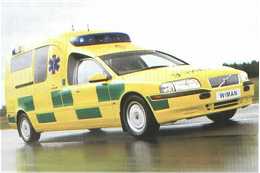
One of the emergency vehicles that has
appeared at previous Exhibitions.
Sir John Charnley was Consultant Orthopaedic surgeon at what is now Trafford General Hospital in Manchester in 1947, having taken over the position from Sir Harry Platt, however he spent one day a week at a hospital in Lancashire, which had been built as a T.B. isolation unit. It was called Wrightington. Whilst at Trafford he came up with the idea of a surgical procedure to repair hips that were affected by Arthritis. This was in the form of 'a hemispherical shell to line the acetabulum'- (pelvic socket)- 'which was. pressed over the head of the femur.' This 'shell' was made from a substance called 'Teflon' which is used on non-stick pans today.
By the early 1960's Sir John Charnley had moved to Wrightington full time and his design had evolved to become a complete hip replacement, which 'still used a Teflon socket but now had a metal femoral prosthesis, cemented into the femur', basically replacing the entire hip joint. Following some set backs in the early days, the procedure proved to be a success and so Professor Charnley stated that anyone wishing to perform the procedure HAD TO BE TRAINED AT WRIGHTINGTON, and this is where the link with North Wales comes in.

One of the Orthopaedic surgeons who came to train under Professor Charnley was a gentleman called Robert Owen who was a surgeon at the Robert Jones & Agnes Hunt Orthopaedic Hospital at Oswestry as well as at Abergele. Having completed the course at Wrightington, he returned to North Wales and was the first surgeon to perform the Charnley procedure outside of England, at Abergele Hospital. In the early1970's he left Abergele to become a Professor in Orthopaedic surgery at the University of Liverpool. There is another twist in this tale, which returns us to Wrightington. Between 1965 and 1969 (approximately) Mr Owens registrar was a man called Michael Wroblewski, he went to Wrightington to do the Charnley Course where he became registrar to Sir John Charnley and was subsequently appointed to the Consultants post at Wrightington in 1973 and has remained there to this day now holding the position of Professor in Bio Mechanical Engineering at Manchester University.
Going back to the development of the procedure by Sir John Charnley, unlike most other surgeons, he not only developed the implant but the whole procedure, from the instrumentation right down to the operating theatre and the suits worn by the surgeons themselves.
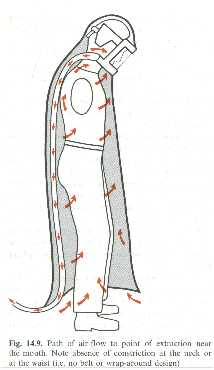
As regards the theatre, this was an unusual design in as much as it was a room constructed within a room. The reason for this and the suits that the surgeons wore was to reduce the risk of infection to the patient, which in the early years reached an unprecedented 7%. To combat this, Charnley designed 'The Greenhouse.' This was a collapsible frame tent that was erected around the surgeon and the operating table completely sealing them in to a sterile enclosure within the theatre.
This idea was further assisted by the introduction of the suits for the surgeons, these Laminar Flow Suits offered complete protection for the surgeon and the patient by preventing any blood spillage contaminating the surgeon and any body born infections from the surgeon entering the wound.
This system is still used in most Hospitals today, although the collapsible tent has been replaced by a permanent structure with its own air conditioning and is commonly known as the 'Howarth Operating Theatre', after the Air Conditioning Engineer who helped design it, or as a 'Laminar Flow Theatre' which describes the air flow around the theatre and more importantly around the surgeon.
As I mentioned earlier Sir John Charnley is the main theme of the display this year, however, as it would appear in previous years that the ambulances have attracted as much interest as the other displays I have put on, I have managed to arrange for the loan of at least three vehicles for the duration of the display with the possibility of others coming for part if not all of the display.

On previous exhibitions notably Afonwen in North Wales we have had up to four vehicles on display for the duration of the exhibiton. On that particular occasion they were a ... 1960's Flintshire County Council Ambulance, 1970's Bedford Ambulance, 1990's Mersey Regional Ambulance Service Vehicle and a 2000 Volvo S80 Ambulance Service Vehicle.


Mersey Regional Ambualnce Service Uniform.

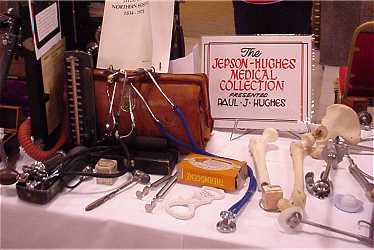
The collection , which now contains well over 500 items of medical and surgical equipment together with uniforms and text books that date back to 1850, was started 6 years ago in Formby near Southport.


Paul J. Hughes
Tel. 017048 73968
Mobile: 07899775784
Where the collection is housed is not open to the general public, but displays and exhibitions open to the public can be arranged through Paul J. Hughes.