Contact Seller
Jason Clarke Antiques
Tel07815 046645Please quote Antiques Atlas.

 Wind speed anemometer by Thos Armstrong & Bros
 Early Victorian Cooke's Drainage Level for Casella
 Improved Portable Chondrometer by RB Bate
 Victorian Hair Hygrometer by Poulenc Freres Paris
 Late 19th Century Cupping Set
 Douglas Reflecting Protractor by Cary
 Hygrodeik or Hygrometer by Short & Mason
 Victorian Microscopy Candle Shade by Pillischer
 Victorian Cased Pocket Galvanometer by Alfred Apps London
 Victorian Gold Pedometer by Negretti & Zambra
 1862 Exhibition Medal for Smith Beck & Beck
 Vintage Customs & Excise Endometer Gauge, English
Non UK callers :
+44 7815 046645
Very Early Wimshurst Machine



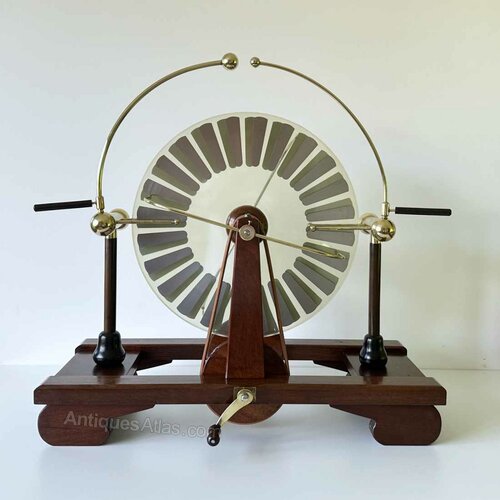
For sale, a very early example of a Wimshurst Machine in accordance with Wimshurst’s original design.
This large example has a mahogany base with scrolled feet and two contra rotating seventeen-inch glass discs. The discs are rotated by means of two turned mahogany wheels with leather bands attached to a spindle on which the discs are attached. By turning the brass and turned mahogany handle, electrostatic charge is collected from the discs via the collecting pins sited at either side and then released between the two brass nodes which are positioned above the machine and are pivoted on two insulated ebonite arms to allow for lengthening or shortening of the spark whilst in demonstration.
What differentiates this magnificent machine from later examples is the absence of a set of integral Leyden jars which are ordinarily placed behind the discs to store a build-up of charge prior to the spark release. In similarity to James Winshurst’s original design, the machine was built to work alongside an external battery of Leyden jars to be used in conjunction with the instrument. The absence of Leyden jars does not affect the machine’s ability to create a spark gap but it simply provides a smaller and more rapid spark due to the absence of the charge storage facilitated by the jars. It could of course be altered if an external set of Leyden jars was used in conjunction with the apparatus.
This is perhaps the earliest example I have owned, notable for its spark gap nodes that align to the circumference of the glass discs, the absence of Leyden jars and its general design with Wimshurst’s original which now resides in the Science Museum. Wimshurst originally used rosewood for the columns holding the collectors whereas this example is constructed of ebonite, a material that had been in use since 1851. Its replacement was presumably due to its superior insulating qualities.
The Wimshurst influence machine or electrostatic generator was developed by the British inventor James Wimshurst between 1880 & 1883.
James Wimshurst was the Chief Shipwright Surveyor for Lloyds of London but dedicated his spare time to scientific experimentation. Widely known for his experiments with electricity, he became a member of the Institute of Electrical Engineers in 1889 and was elected a Fellow of the Royal Society in 1898.
Circa 1885
SellerJason Clarke Antiques
View all stock from
Jason Clarke Antiques

 Private dealer
By appointment only
Newbury
Berkshire
Tel : 07815 046645
Non UK callers : +44 7815 046645
This large example has a mahogany base with scrolled feet and two contra rotating seventeen-inch glass discs. The discs are rotated by means of two turned mahogany wheels with leather bands attached to a spindle on which the discs are attached. By turning the brass and turned mahogany handle, electrostatic charge is collected from the discs via the collecting pins sited at either side and then released between the two brass nodes which are positioned above the machine and are pivoted on two insulated ebonite arms to allow for lengthening or shortening of the spark whilst in demonstration.
What differentiates this magnificent machine from later examples is the absence of a set of integral Leyden jars which are ordinarily placed behind the discs to store a build-up of charge prior to the spark release. In similarity to James Winshurst’s original design, the machine was built to work alongside an external battery of Leyden jars to be used in conjunction with the instrument. The absence of Leyden jars does not affect the machine’s ability to create a spark gap but it simply provides a smaller and more rapid spark due to the absence of the charge storage facilitated by the jars. It could of course be altered if an external set of Leyden jars was used in conjunction with the apparatus.
This is perhaps the earliest example I have owned, notable for its spark gap nodes that align to the circumference of the glass discs, the absence of Leyden jars and its general design with Wimshurst’s original which now resides in the Science Museum. Wimshurst originally used rosewood for the columns holding the collectors whereas this example is constructed of ebonite, a material that had been in use since 1851. Its replacement was presumably due to its superior insulating qualities.
The Wimshurst influence machine or electrostatic generator was developed by the British inventor James Wimshurst between 1880 & 1883.
James Wimshurst was the Chief Shipwright Surveyor for Lloyds of London but dedicated his spare time to scientific experimentation. Widely known for his experiments with electricity, he became a member of the Institute of Electrical Engineers in 1889 and was elected a Fellow of the Royal Society in 1898.
Circa 1885
Price
Arrange a final price and delivery details directly with the dealer
Click here to message the seller The price has been listed in British Pounds.
Conversion rates as of 8/OCT/2026. Euro & Dollar prices will vary and should only be used as a guide.
Always confirm final price with dealer.
Category Scientific Antiques
Period Late Victorian Antiques
Material Mahogany
Origin English
Item code as542a918
Status For Sale
£3500.00 
$4629.10
€4130.00

$4629.10

€4130.00

Looking to Buy?
Payment with PayPal is availableArrange a final price and delivery details directly with the dealer
Click here to message the seller

Conversion rates as of 8/OCT/2026. Euro & Dollar prices will vary and should only be used as a guide.
Always confirm final price with dealer.
View all stock from
Jason Clarke Antiques

 Private dealer
By appointment only
Newbury
Berkshire
Tel : 07815 046645
Non UK callers : +44 7815 046645
You may also be interested in
 Wind speed anemometer by Thos Armstrong & Bros
 Early Victorian Cooke's Drainage Level for Casella
 Improved Portable Chondrometer by RB Bate
 Victorian Hair Hygrometer by Poulenc Freres Paris
 Late 19th Century Cupping Set
 Douglas Reflecting Protractor by Cary
 Hygrodeik or Hygrometer by Short & Mason
 Victorian Microscopy Candle Shade by Pillischer
 Victorian Cased Pocket Galvanometer by Alfred Apps London
 Victorian Gold Pedometer by Negretti & Zambra
 1862 Exhibition Medal for Smith Beck & Beck
 Vintage Customs & Excise Endometer Gauge, English